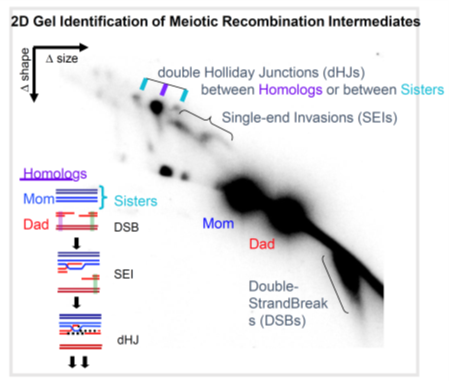
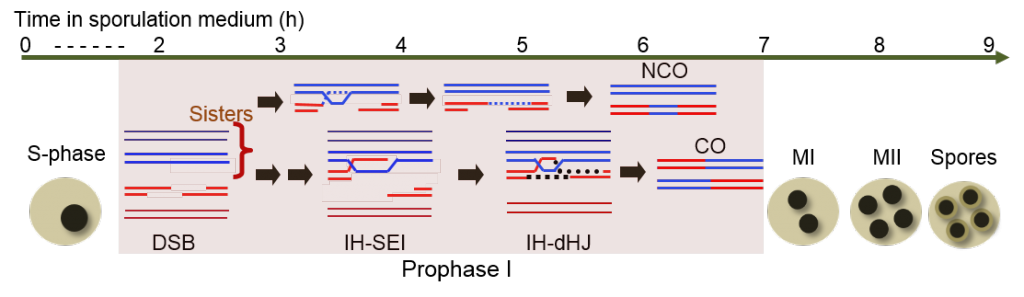
Spontaneous mitotic DSB exhibits inter-sister bias. Programmed DSB-initiated meiotic recombination exhibits inter-homolog bias. How does a double-strand break (DSB) choose a sister partner during mitotic DSB repair but a homolog partner during meiosis? In the standard paradigm, the sister is selected automatically by spatial proximity while meiosis-specific features confer homolog bias. Kim’s group study a different paradigm from physical analysis in yeast meiosis. Regardless of whether strand exchange is promoted by Rad51 in a mitotic DSB repair-like mode, or by meiotic RecA homolog Dmc1 in meiosis, a DSB preferentially selects a homolog partner. In mitotic-like mode, sister bias is then actively enforced by cohesin, likely independent of cohesion per se. In meiosis, cohesin again enforces sister bias, but meiosis-specific features (meiotic RecA homolog Dmc1, meiotic axis complex Red1/Mek1/Hop1 (RMH complex) and reprogrammed Rad51 and its mediators) counteract that enforcement. Homolog bias is thus restored without compromising global cohesion.